
Harnessing the Power of Wind and SunPostdoctoral Researcher Ester Hamatwi Aims to Advance the Energy Transition in Africa Through Her Work at Aalen University of Applied Sciences
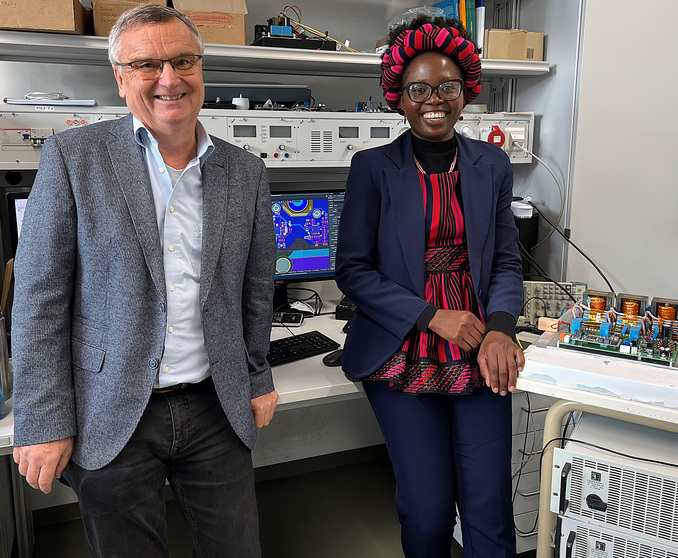
Researching Sustainable Energy Systems: Prof. Dr. Heinrich Steinhart and Dr. Ester Hamatwi, who came to Aalen for her postdoctoral research from Namibia. Photo: © Aalen University of Applied Sciences | Saskia Stüven-Kazi
Flipping a light switch, opening the refrigerator, charging a smartphone—what seems completely natural to many of us is still far from reality for millions of people worldwide. Around 700 million people still have no access to electricity. Rural regions on the African continent are particularly affected, as expanding centralized power grids in remote, sparsely populated areas is often not economically viable. One of the most promising solutions lies in so-called microgrids—local, intelligent energy networks. This is precisely the focus of Dr. Ester Hamatwi’s research.
For her postdoctoral studies, the electrical engineer from Namibia came to Aalen University of Applied Sciences. Over the past months, she has advanced her research in the field of renewable energy. “Through my work, I want to contribute to the energy transition in Africa,” Hamatwi explains.
“Like Magic”
Dr. Ester Hamatwi knows from personal experience what it means to grow up without electricity. She comes from a small village in northern Namibia near the Angolan border. “There was no electricity there—not even at school. We used candles or paraffin lamps to study at night,” the 32-year-old recalls.
When she later moved to the city to attend high school, she saw streetlights for the first time. “When they started to light up in the evenings, it felt like magic,” Hamatwi remembers. She wanted the same for her home village, knowing that the lack of access to electricity has proven negative effects on education, health, and nutrition.
“I wanted to improve living conditions in my village. One of my sisters is a civil engineer and inspired me to think in the direction of electrical engineering,” Hamatwi says.
A Passion for Mathematics and Technology
From an early age, the electrical engineer eagerly and curiously took things apart together with her siblings. “You have to understand how everything works!” the scientist says with a laugh. She has always had a strong affinity for mathematics and technology.
After completing her bachelor’s degree at the University of Namibia, she went on to earn a master’s degree in electrical engineering at the University of KwaZulu-Natal in Durban, South Africa. Hamatwi then pursued her doctorate at the University of Cape Town. Since 2022, she has been teaching and conducting research at the University of Namibia in the field of sustainable energy solutions and rural electrification, with a specialization in solar and wind energy systems.
“Namibia is about two and a half times the size of Germany, but has a population of only around 3.1 million. It is a dry country with abundant sunshine and vast deserts,” Hamatwi explains, adding with a smile: “We have plenty of space for solar power plants.”
Autonomous “Island Grids”
Over the past months, she has conducted research as a scholarship holder of the German Research Foundation (DFG) at the Laboratory for Power Electronics and Electrical Drives at Aalen University of Applied Sciences, under the supervision of Prof. Dr. Heinrich Steinhart. Her work focused on the modeling of hybrid renewable energy systems that integrate photovoltaic power, wind energy, and battery storage systems.
“Public utility lines do not make economic sense in rural areas where there are many small villages, often with only around 80 inhabitants. For this reason, decentralized energy supply needs to be expanded,” Hamatwi explains. This is where so-called microgrids come into play—small, independent power networks capable of securing energy supply. Such autonomous “island grids” combine renewable energy generation from sources such as solar and wind power with energy storage systems into a localized network.
A Gain for the University
Her research findings are now set to feed into a collaborative project with the German Corporation for International Cooperation (GIZ). She is supported by Prof. Dr. Heinrich Steinhart, who has spent time in Namibia and is familiar with local living conditions. “It’s wonderful to share knowledge. Having international researchers on board is a great asset for our university. It also allows our students to gain a broader perspective,” Steinhart explains.
An Exciting Development in Every Sense
“It has been fantastic to conduct research here at Aalen University. The laboratories are very well equipped, and the exchange with other researchers has been incredibly enriching for me,” Hamatwi says enthusiastically. “I am already looking forward to passing on all the newly acquired knowledge to my students.”
As passionate about teaching as she is about research, the 32-year-old emphasizes: “You always have to know more than your students. And when you don’t know something, you need to read up and research it.” Looking ahead, Hamatwi plans to pursue a professorship. With a smile, she adds: “I love constantly learning. After all, there are always advances in my field, and the developments are fascinating.” Truly, in every sense of the word.