
Onboarding Made EasyWelcome Center Ostwürttemberg Celebrates Five Years of Service
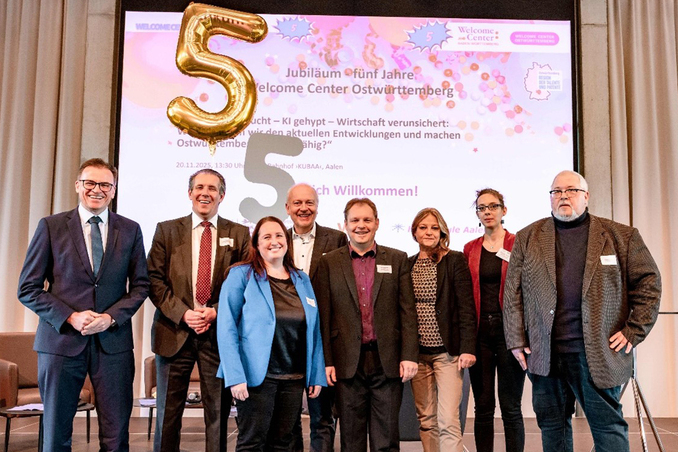
Dr. Joachim Bläse, Chief Officer of the Ostalb District; Peter Polta, Chief Officer of Heidenheim District; Nadine Kaiser, Managing Director WiRO; Prof. Dr. Harald Riegel, President of Aalen University; Steffen Kohnle, Director Welcome Center Ostwürttemberg; Susanne Vedder of the Baden-Württemberg Ministry of Economic Affairs, Labour and Toursim; Solveigh Gauditz, Adviser at the Welcome Center Ostwürttemberg; and Pascal Cromm, Director International Office at Aalen University.
Around 80 guests from companies, universities, public administration and regional networks attended the anniversary event of the Welcome Center Ostwürttemberg at the KulturBahnhof Aalen last week.
Five years ago, the Welcome Center Ostwürttemberg, operated by the Regional Economic Development Agency Ostwürttemberg (WiRO) in cooperation with Aalen University, began its work. Under the title “Workers Wanted – AI Hyped – Economy Uncertain: How Do We Respond to Current Trends and Secure the Future of Skilled Labor in Ostwürttemberg?” the anniversary event offered concrete perspectives on the future of workforce development in the region through insights from academia and industry as well as a panel discussion. It also impressively highlighted the valuable contribution the Welcome Center is already making today to the “Region of Talents and Patents.”
District Officer Joachim Bläse emphasized the importance of the Welcome Center for the region in his welcoming address:
“International talents are a key pillar of our skilled labor strategy. The Welcome Center provides orientation, removes barriers, and strengthens a genuine culture of welcome in Ostwürttemberg. It has become a central point of contact that supports both our companies and international professionals.”
Aalen University’s President Harald Riegel also highlighted the role of international students and the close cooperation between the university and the Welcome Center:
“International students make a significant contribution to the innovative strength of our region. They bring expertise, motivation, and fresh perspectives. The Welcome Center connects them with companies at an early stage, making it easier for them to arrive, settle in, and integrate into our region.”
In her keynote, “Resilient Companies in Uncertain Times: Strategic Approaches to Securing Skilled Labor,” Sibylle Stippler of the German Economic Institute addressed the continued importance of immigration in the years ahead and outlined the potential she sees for the Ostwürttemberg region.
Stippler noted that “knowledge is retiring,” and that there is a particular shortage of young professionals with completed vocational training. She outlined strategic levers for tapping domestic labor potential, increasing productivity—such as through digitalization—and strengthening vocational education and training. “We will not manage without international skilled workers,” she emphasized. Too few companies, she added, currently view the recruitment of international professionals as an opportunity to meet their own workforce needs, and many also fail to take advantage of the potential offered by international students.
As strengths of the region, Sibylle Stippler highlighted competitive salaries for experts, strong innovative capability and a low insolvency rate. However, she also pointed to areas requiring improvement, including online administrative services, the low employment rate among women and the availability of fiber-optic broadband. She praised the region for its attractive employers, innovative capacity, high quality of life and strong cooperation networks — and, not least, for the Welcome Center Ostwürttemberg as an important institution for securing skilled labor.
In the subsequent panel discussion, Viktoria Bohn from the Transformation Nettwork Ostwürttemberg, Ramon Rank from the Ostwürttemberg’s Chamber of Commerce, Mazen Abou Elfadil of PTS Prüftechnik GmbH, Verena Andrei, coordinator of the Welcome Centers in Baden-Württemberg, and Sibylle Stippler engaged—together with audience questions—in a discussion on the relevance of continuing education, the role of Welcome Centers in securing skilled labor, and the impact of AI.
The afternoon also featured a review by the Welcome Center team of five years of operations. The team reported providing more than 1,700 consultations for international students, skilled professionals and companies, along with numerous events and awareness-raising activities that have firmly anchored the concept of a welcoming culture in the region. The conclusion is clear: the services are widely used, and demand continues to grow.
The Welcome Center is looking confidently to the future: the project will continue to receive funding for another three years from the Baden Württemberg’s Ministry of Economic Affairs, Labour and Tourism. At the same time, the required co-financing will remain supported by a broad regional alliance — including the two districts of Ostalb and Heidenheim, the cities of Aalen, Ellwangen, Giengen, Heidenheim and Schwäbisch Gmünd, as well as the Chamber of Commerce Ostwürttemberg and the Chamber of Handcrafts Ulm. This ensures that decentralized advisory services and regional activities can continue to be offered directly on site in the future.