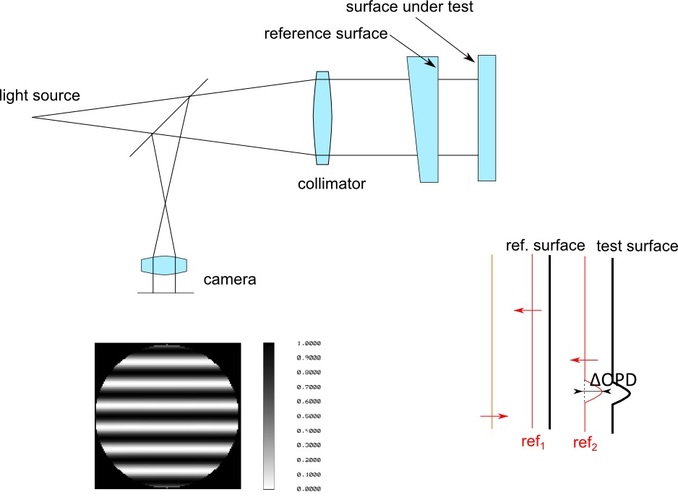
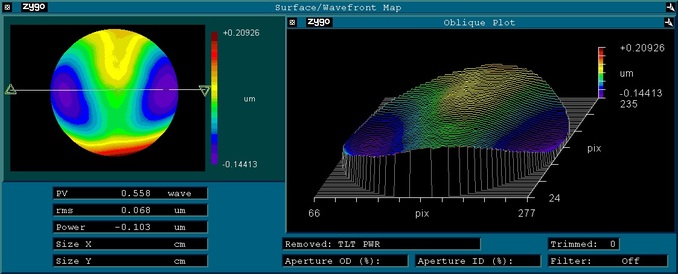
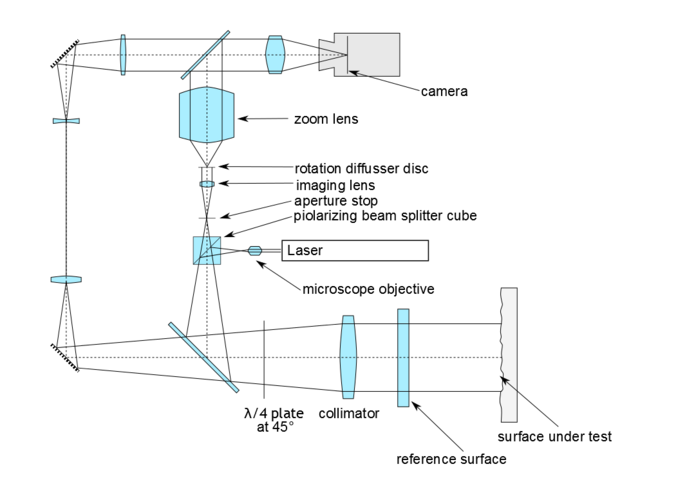
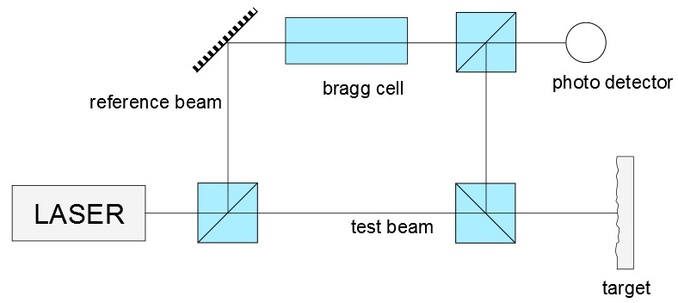
In an interferometer, the light from the point light source is transformed into a plane wave using a collimator. This is reflected at the reference and test surfaces (ref1 and ref2). The two superimposed waves are then imaged on the camera, where an interference pattern is created. The different interference patterns result from optical path differences (OPD).
For example, if we investigate/analyze a tilted mirror, we can observe a pattern of light and dark stripes. If the wavelength is known, the exact tilt angle can be determined.
The interferometers can be used to measure flat, spherical and aspherical surfaces. The refractive index of lenses can also be determined - with a little extra effort. The measurement error when measuring surfaces varies from equipment to equipment and is 0.1 nm for a white light interferometer, for example.
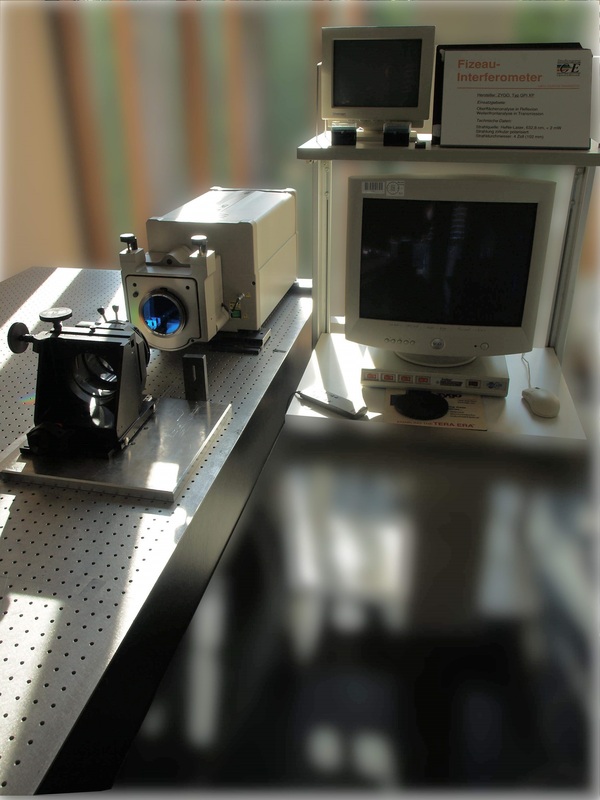
The available interferometers are: a Zygo GPI XP, a Zygo NewView 200 microinterferometer (white light interferometer, combines microscopy & interferometry), a Zygo NewView 8300 microinterferometer and a Carl Zeiss D100.