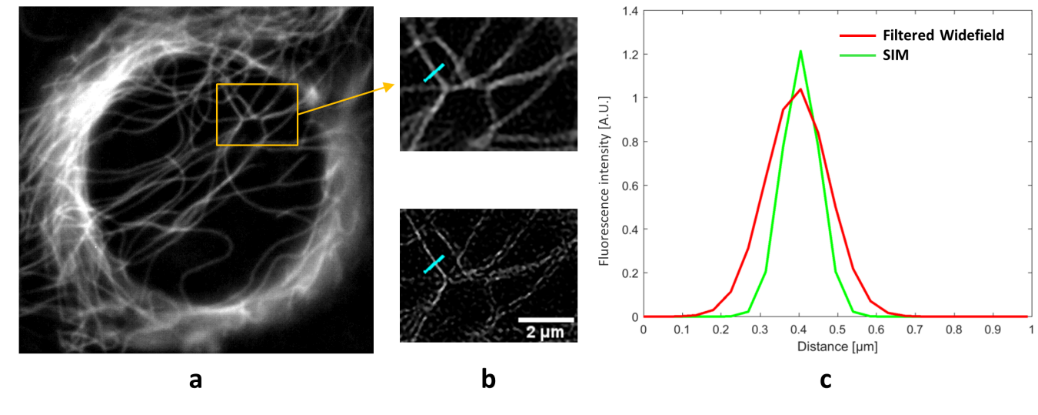
With the developed methods of structured illumination microscopy (SIM) and axial tomography, a significant step was taken towards super-resolution microscopy with a resolution of less than 100 nanometers. Among other things, this enabled high-resolution imaging of the cytoskeleton as well as the cellular uptake and distribution of various metabolites, e.g. cytostatics (cooperation with Prof. Dr. C. Cremer, University of Heidelberg).
Figure: Visualization of the cytoskeleton after staining with Tubulin TrackerTM Green with wide-field microscopy (a) and Structured Illumination Microsocpy, SIM (b); from V. Richter, M. Piper, M. Wagner, H. Schneckenburger: Appl. Sci. 9 (6) (2019) 1188.
Herbert Schneckenburger has been researching and teaching as Professor Emeritus at Aalen University of Applied Sciences and the University of Ulm since fall 2019. He is invited worldwide to give scientific lectures or talks as part of the Student Chapter of the SPIE (Society for Optical Engineering). He is also a sought-after international reviewer and author of almost 300 scientific publications. He is currently researching the following topics:
- Application of high-resolution microscopy methods in cell biology and molecular medicine
- Measurement of subcellular transport processes and intermolecular interactions in the nanometer range for research into active pharmaceutical ingredients (in cooperation with the Forschungs- und Entwicklungs-GmbH at the University of Applied Sciences Upper Austria).
- Use of functionalized additively manufactured optics for fluorescence microscopy (as a sub-project of a Baden-Württemberg-Stiftung gGmbH research project led by Prof. Dr. A. Heinrich).
Project staff: Dr. Verena Richter, Dipl.-Ing. (FH) Michael Wagner MSc, Claudia Hintze