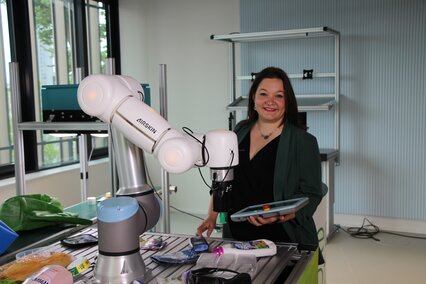
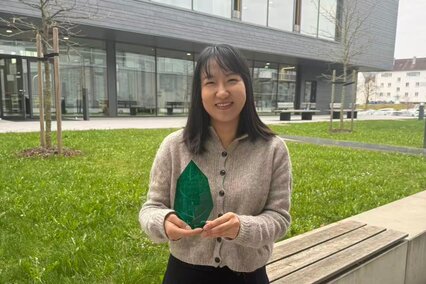
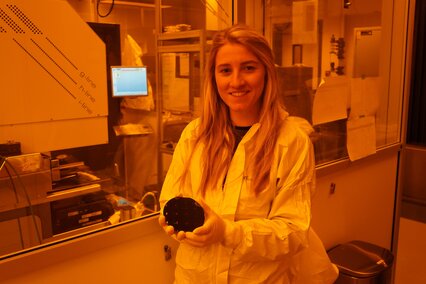
Selina Burkert showed a keen interest in science at an early age. At grammar school, she studied biology and art, attended a physics club and took part in the "Jugend forscht" competition several times. The desire to do research herself grew with each experience. After graduating from high school, she therefore decided to do a dual course of studies in mechatronics at the Baden-Württemberg Cooperative State University in Mosbach. At the same time, she worked at Carl Zeiss SMT, where she gained her first practical experience working with engineers - and made a decision: "After my Bachelor's degree, I knew that I wasn't finished yet," says the Ellwangen native with a laugh, describing her motivation at the time to continue on her chosen path.
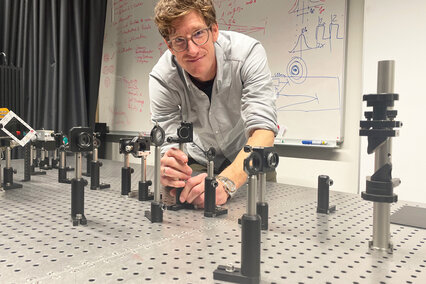
That's why she went on to complete a research master's degree at Aalen University of Applied Sciences under Prof. Dr. Andreas Heinrich. The Professor of Optics heads the research group for micro- and nanophotonics at the Aalen School of Applied Photonics (AASAP), which unites the Center for Optical Technologies (ZOT) and the LaserApplicationCenter (LAZ) under one roof - in combination with training in applied optics at all academic levels. He is now also supervising Selina Burkert's doctorate, which she began after completing her Master's degree at AASAP and is now in the final phase.
Tiny needles with a big impact
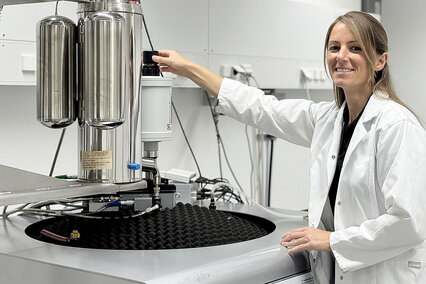
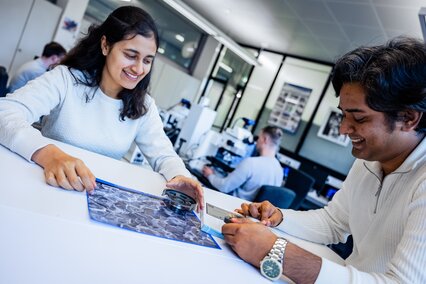
A central component of her work is microneedles - tiny structures that are designed to introduce medication into the skin almost painlessly. They are produced using two-photon polymerization, a high-precision 3D printing process. In this process, a liquid, light-sensitive material is cured with pinpoint accuracy using a focused laser. This creates three-dimensional structures in the micro and nano range. The vision: a plaster that delivers medication automatically and without a noticeable puncture. Active ingredients such as insulin, hormones or painkillers are transported into the tissue via fine channels in the needles. At the same time, Selina Burkert is working with her colleague Cordelia Wittemann on equipping the needles with optical sensors. This can measure how a drug is distributed or dissolved in the body. This is still research: "We are currently generating a lot of data to understand how the delivery behaves in the tissue," explains the doctoral student. The technical challenge is considerable. The needles have to be stable but barely noticeable. At the same time, they must contain cavities - a problem for conventional manufacturing processes. This is why Selina Burkert is researching nanoimprint lithography, among other things. In this process, a structured shape is pressed into a soft, UV-sensitive material like a stamp and then cured using UV light to create extremely fine patterns. In this way, even the smallest channels can be produced through which the medication can be delivered. The project, which is funded by the Federal Ministry of Research, Technology and Space, is part of an interdisciplinary research network within Aalen University of Applied Sciences. In addition to AASAP, the Mechatronics and Physician Assistant degree programs are also involved. Industrial partners such as Actuator Solutions GmbH from Gunzenhausen are also involved.
Optics for augmented reality
A second, growing field of research leads Burkert into the area of augmented reality. She is working on optical structures that could be used in virtual reality glasses in the future. The challenge is to apply functional optical elements directly to curved surfaces such as spectacle lenses. These structures are designed in such a way that they deflect light in a targeted manner and couple a projected image directly into the eye. In everyday life, this could mean Navigation instructions appear in the field of vision without the need for a separate display. Information is displayed directly where it is needed. Unlike many companies, Burkert is not working on the finished product, but on the basic technologies that make such applications possible in the first place. Nanoimprint lithography also plays a key role here. The optical-functional structures are imprinted from a master and can be replicated quickly in this way. These are so fine that they remain invisible to the eye, but can still perform complex optical functions. The aim is to produce such structures efficiently and on a large scale so that they can be integrated into everyday glasses in the future.
Research for society
"In addition to budgets from industry cooperations, we work with funding that was originally taxpayers' money. That's why we want to give something back to the general public and publish lots of specialist articles so that other researchers can build on them," says Selina Burkert, explaining the social dimension of her work. The doctorate itself is a long-term project that requires patience and, above all, curiosity. For Selina Burkert, this is precisely where the appeal lies: finding new ways to create structures that are far smaller than a human hair - and yet have the potential to significantly improve future optical technologies. Her research is an example of how much fundamental work is behind technologies that will later be taken for granted by everyone.