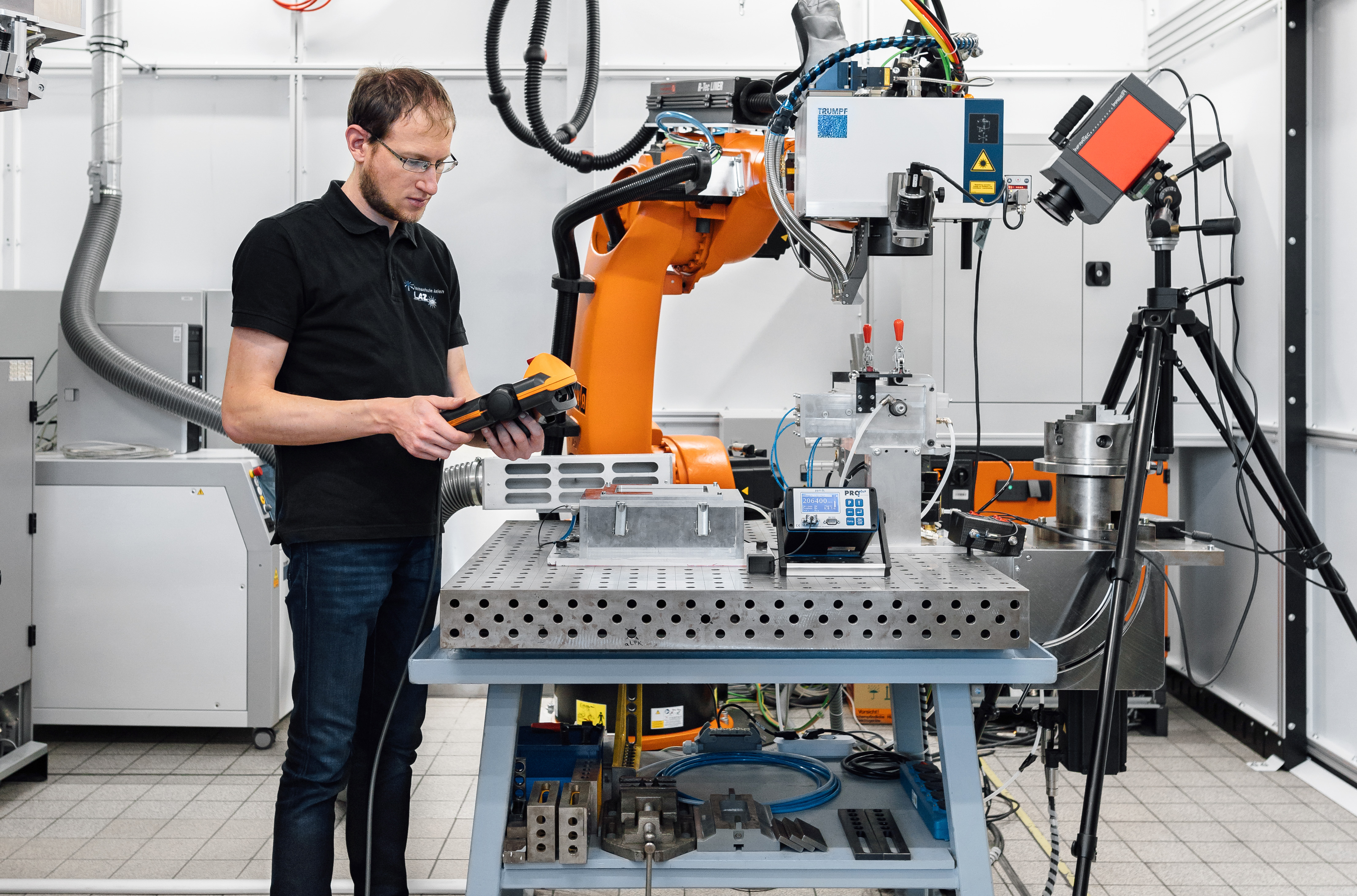
Joining techniques include laser beam welding and laser beam soldering: laser welding creates material-locking, metallic Fraternities and sororities/clubs in numerous seam and joint configurations. The outstanding feature of laser soldering is the non-contact melting of the solder with exact distribution of the energy supply to the solder and joining partner. We also have various attachments available for this, such as the TLC 1005, which consists of; have five axes and an additional rotary axis for 3D processing. It can be used for welding and high-temperature soldering. Thanks to various laser sources, our 6-axis robot not only enables 3D material processing in the robot cell, but also robot-assisted adhesive joining.
Laser beam welding
In this joining process, an inseparable joint is created between two workpieces or components with targeted heat input. As a rule, none of the filler material is used. For welding, a laser beam is pooled by focusing optics and directed at the workpiece. The joint is then heated to welding temperature. A gas protects the weld seam to prevent oxidation. As the heat input remains low due to the strong bundling of the laser beam, the components exhibit little distortion. The weld seams are usually very narrow. Areas of application include sheet metal processing and Tool making & forming.
Laser beam soldering
The laser is ideal for the three soldering processes - soft soldering, hard soldering and high-temperature soldering. It works without contact and the parameters are easy to control, making laser beam soldering a good alternative to welding for Fraternities and sororities/clubs with high demands on temperature resistance and mechanical strength. Laser soldering is usually realized using a soldering optic that is integrated into a robot. The laser beam is guided along the joint where it melts the brazing alloy - such as a copper-silicon wire - and thus joins the components. The success of the laser soldering process is based on the weld-like strength and the high aesthetic quality of the joints: Laser soldered seams are known for their dense, smooth and clean structures. This is visually attractive and reduces reworking to a minimum.