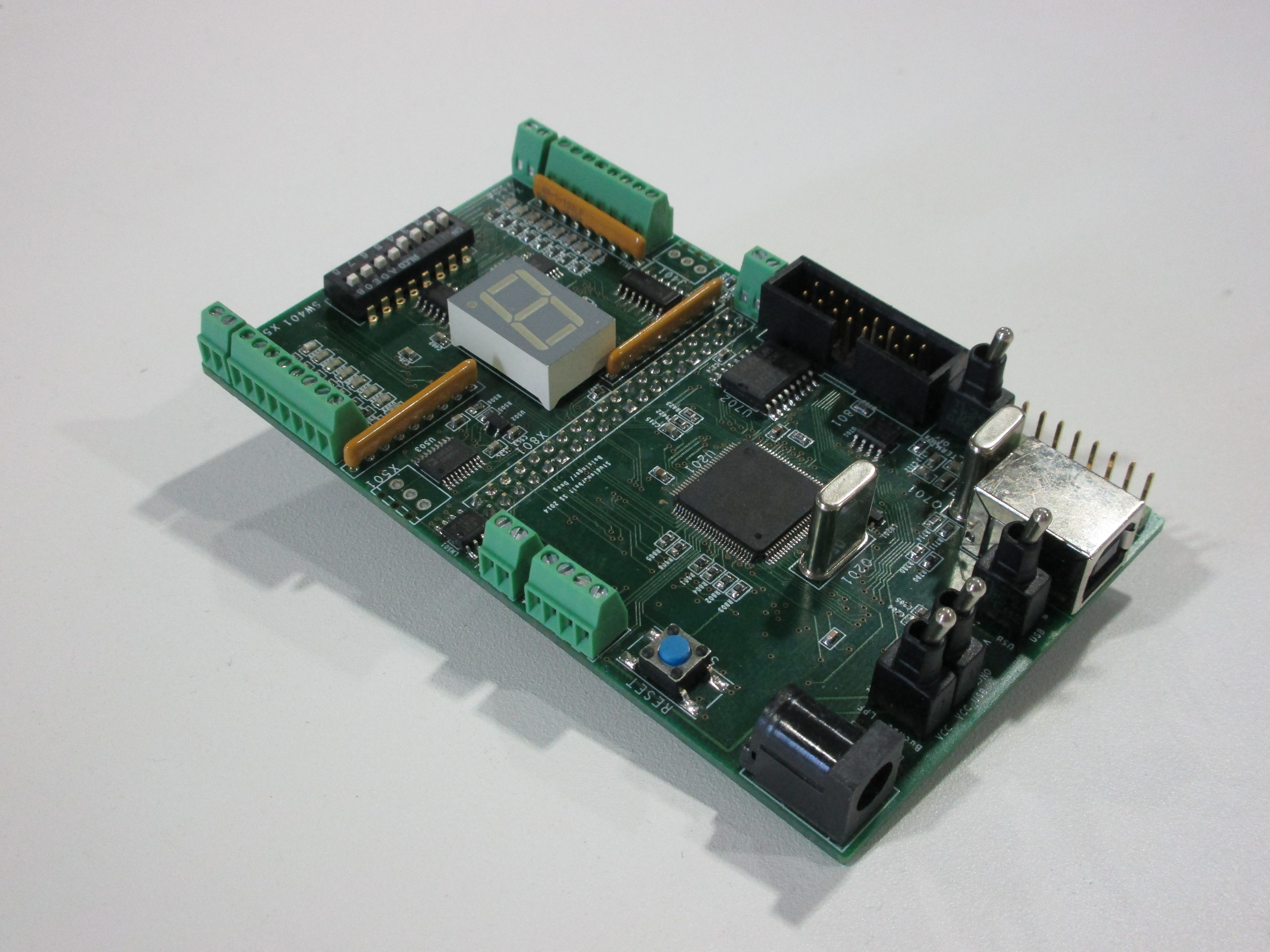
HiL test bench
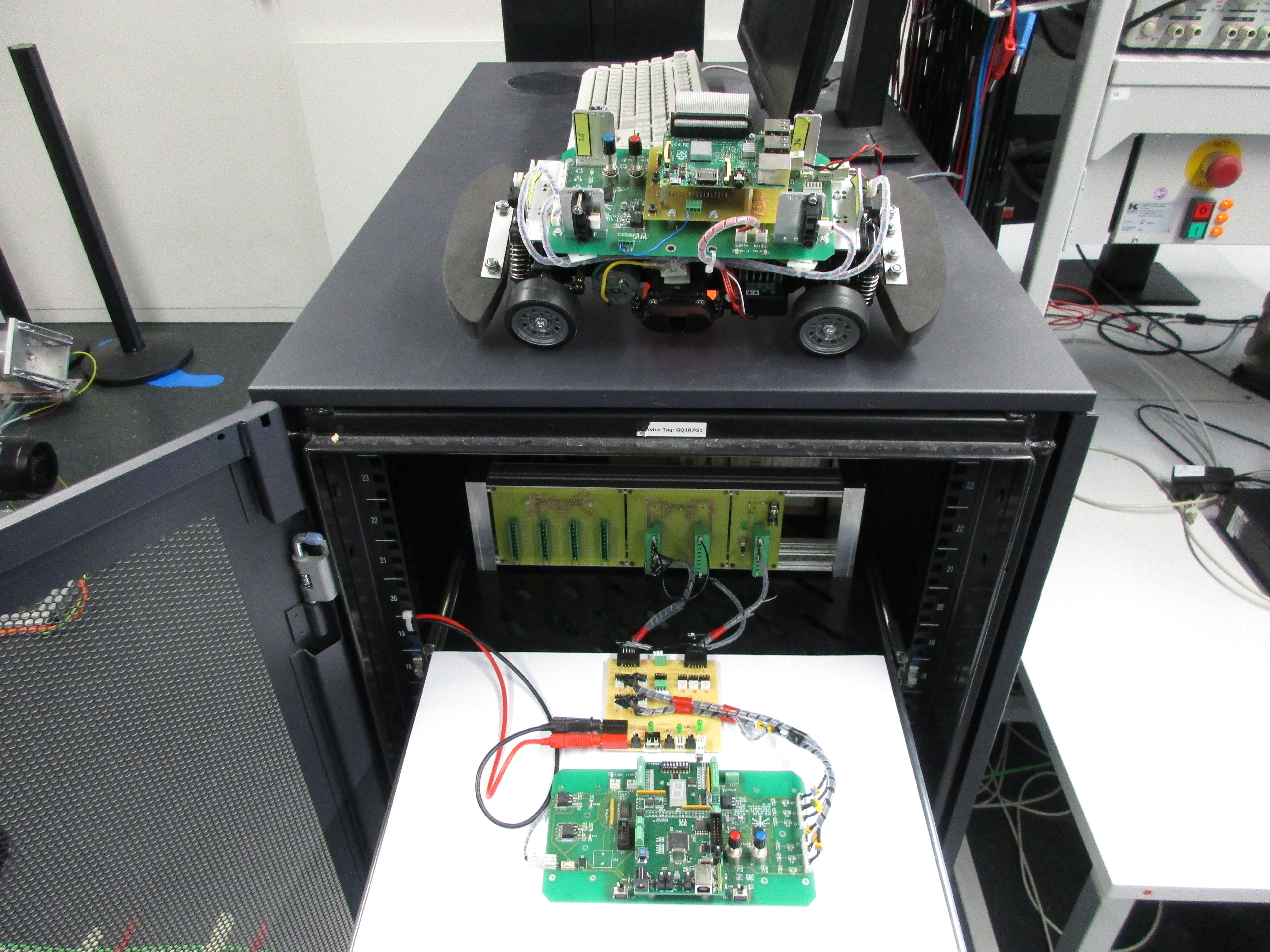
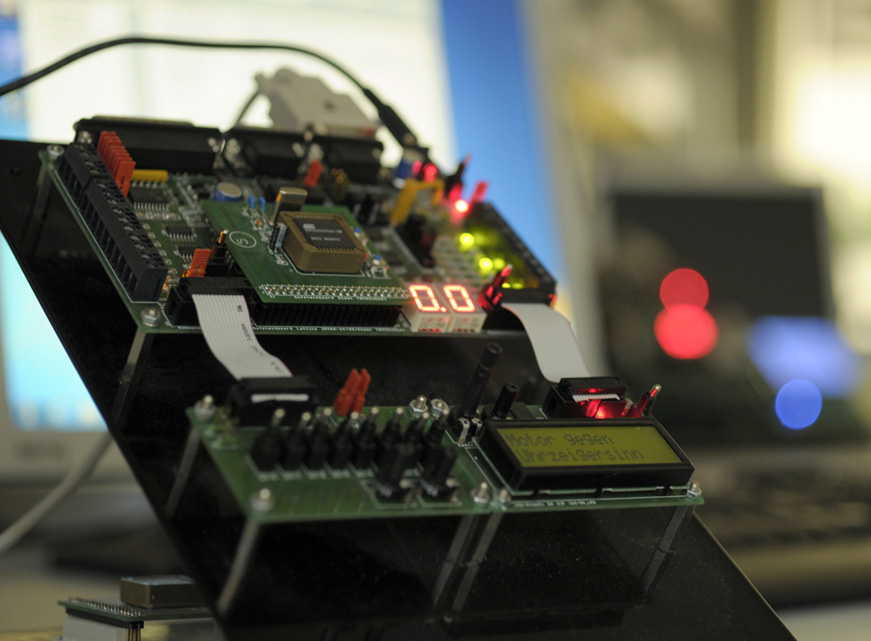
The HiL test bench offers the possibility to test your own software on the original hardware, e.g. the control unit (i.e. hardware in the loop). For this purpose, a model is created of the hardware environment that corresponds to the intended use and is as close as possible to reality.
The control unit receives information via its sensor interface as it would in reality and thus reacts to an almost real situation. On the other hand, the Hil test bench records the actuator interface of the control unit and can thus evaluate the system reaction or react to it itself with the aid of the environment model.
In the context of this project, problems from the fields of control engineering, control technology and test procedures for control software are dealt with. In addition, the HiL test bench is a very popular topic in the automotive industry.
RCP for a lifting element with a Lorentz actuator
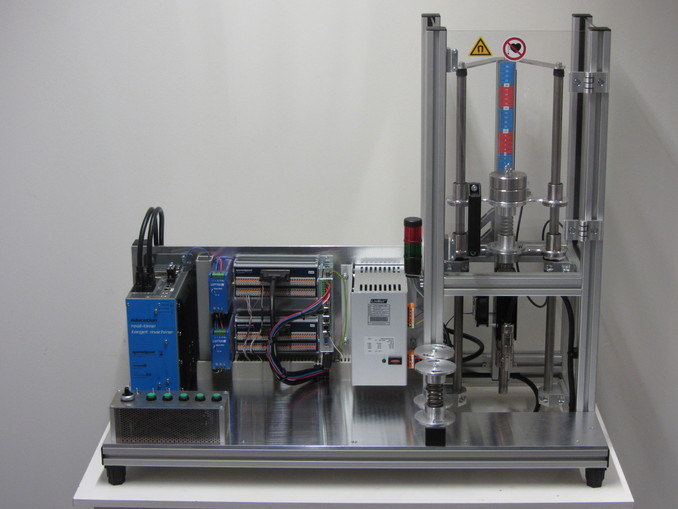
The setup serves as a learning module for a laboratory on control engineering in the bachelor's degree course in mechatronics. A Lorentz actuator positions an elastically coupled load mass with weak damping highly dynamically and precisely to a specified target position, whereby both the load mass and the elastic coupling can be varied. The position of the load mass is detected by an additional magnetic band sensor and fed to the controller.
The controller design and state control is realized in Matlab-Simulink and -Stateflow and loaded as an executable xPC target into the 32-bit real-time platform "Real-Time-Target Machine" from Speedgoat. Different controller structures (e.g. PID/cascade/state controllers) as well as different motion profiles (acceleration- or jerk-limited or sinuid profile) can be realized. If necessary, the relevant kinematic signals can be tracked via a target monitor.
In the learning module, the controller structure and the control system are first developed and optimized using MiL simulation (model-in-the-loop) and then tested in the real system using rapid control prototyping.
RCP for a linear servo axis with toothed belt drive
This setup serves as a learning module for a laboratory on control engineering accompanying lectures in the Bachelor's degree course in Mechatronics. The rotary motion of a synchronous servomotor is converted into a linear motion via a toothed belt axis to position an elastically coupled load. An eddy current brake and interchangeable springs can be used to vary the degree of damping and spring constant of the spring-mass damper system (FMD system). The position of the load mass is detected by an additional magnetic tape sensor and fed to the controller via the servo controller.
The controller design and state control are implemented in Matlab Simulink and Stateflow and loaded as an executable xPC target into Speedgoat's 32-bit real-time platform "Real-Time-Target Machine". Different controller structures (e.g. PID/cascades/state controllers) as well as different motion profiles (acceleration or jerk-limited or sinuous profile) can be realized. If necessary, the relevant kinematic signals can be tracked via a target monitor.
In the learning module, the controller structure and the control system are first developed or optimized using MiL simulation (model-in-the-loop) and then tested in the real system using rapid control prototyping. In addition, the system can also be controlled using a compact controller from Siemens. In this case, the servo controller takes over the control.
The system also has a safety monitoring system. The safety-relevant states of the system are monitored and controlled using a safety control unit from PILZ.