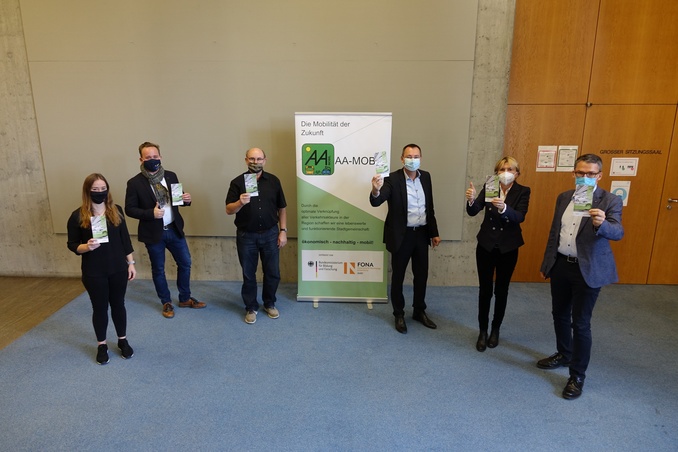
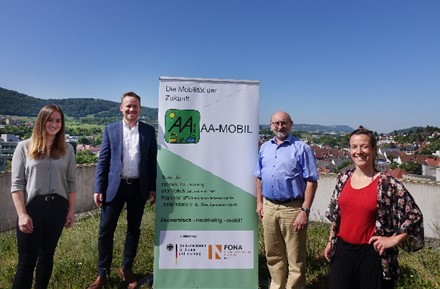
Phase 1 of the "AA-MOBIL" project has been completed (from left): Stefanie Benz, Felix Unseld, Hans-Peter Weber, Mayor Thilo Rentschler, Professor Dr. Anna Nagl and Member of Parliament Roderich Kiesewetter support the progress, not in the photo Anja Hoh
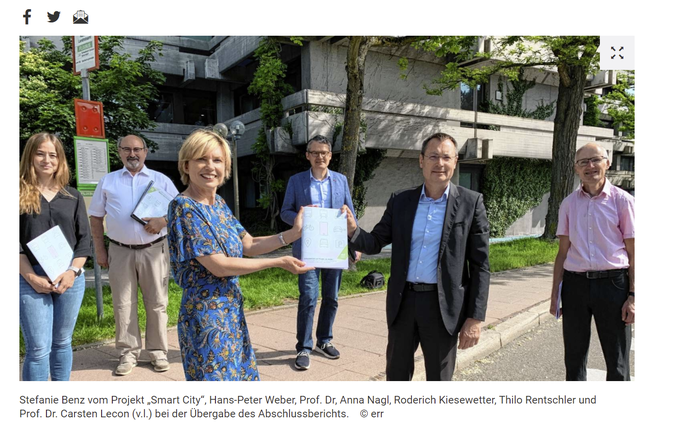
Monday, November 9, 2020: Environmentally friendly and sustainable, but at the same time simple and user-friendly: this is what the mobility concept in Aalen could look like in the future. In order to develop solutions for this, the "AA-MOBIL" transport project was launched and funded within the framework of the "MobilitätsWerkStadt 2025" directive from the Federal Ministry of Education and Research (BMBF). The project team led by business development manager Felix Unseld, Prof. Dr. Anna Nagl from the Competence Center for Innovative Business Models at Aalen University of Applied Sciences, and Hans-Peter Weber, managing board member of OstalbBürgerEnergie eG (OBE), presented its final report in the presence of Aalen's Lord Mayor Thilo Rentschler and Member of the Bundestag Roderich Kiesewetter after almost a year of project work. "The ideas are a good fit with our other Smart City projects," said Lord Mayor Rentschler.
The city of Aalen has outlined a project with the aim of improving the traffic situation, especially commuter traffic, and was selected for this funding along with 50 municipalities across Germany. The precedence to the BMBF research project guidelines "MobilityWorkCity 2025" is the development of concepts to reduce individual traffic and the associated pollutant emissions.
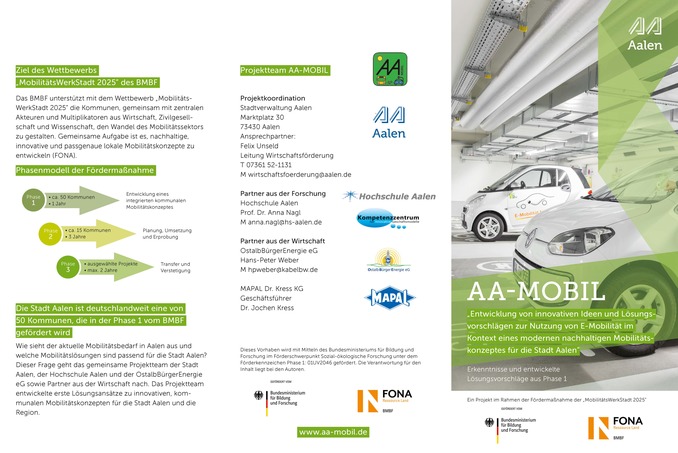
Phase 1, which is to be completed by the end of this year, focuses on the development of innovative ideas and solutions for a modern and sustainable overall mobility concept for the Aalen region. In the subsequent three-year phase 2 of this BMBF funding directive, for which the city of Aalen has submitted a funding application, the aim is to evaluate the proposed solutions and test their implementation with a partner municipality and partner companies. In phase 3, the applicability in pilot projects is to be verified and transferability to other medium-sized centers is to be ensured.
Findings from the survey in phase 1
In phase 1, the main aim was to examine the current traffic situation and to find out people's attitudes with regard to their personal mobility situation and mobility needs. To this end, over 1,300 citizens, employees, companies and bus and rail operators were surveyed. One of the key findings is that a high level of individual mobility is extremely important to people in the region. More than half of those surveyed use their own car to travel to work or educational institutions. Only 15% use public transport, 13% cycle and 8% walk.
Over two thirds own two or more cars in their household; 96% of these cars are powered by an internal combustion engine. 62% of those surveyed would consider switching to an electric vehicle if the opportunity arose. There is a considerable need for information on electric mobility. Five arguments were put forward against electric vehicles: too expensive, too short a range, too few charging stations, too long a charging time and negative environmental aspects of the battery.
There are also information deficits with regard to public transport: from the main train station or the central bus station (ZOB), for example, you can get to the institution of higher education every 10 minutes. Most destinations in Aalen can be reached every 20 minutes. Real-time information is also already available on many bus routes. Overall, however, only 10% of people in Aalen use public transport - this corresponds to the average usage at state level.
Participation as the top priority in this BMBF research project
Proposed solutions were developed in a project workshop in which members of the project team, representatives from the city planning office, civil engineering office and the office for the environment, green spaces and environmentally friendly mobility as well as industrial companies took part. As part of this BMBF research project, a coordinating office for mobility at the city is proposed. In cooperation, cooperative venture, partnership, collaboration, this office would develop a mobility kit tailored to the region, from whose elements the companies and educational institutions could put together their own individual mobility concept. Ideally, they would be given advice, to and accompanied by a mobility coordinator.
A multimodal app should be an important component of the mobility kit. Among other things, this should enable and manage cross-company car pools and company bus routes - making it possible to commute to the desired destinations flexibly in terms of time and connected to buildings and facilities. The necessary information from drivers and carpoolers is to be collected via this platform and stored on a "server administered by the local authority in the region". In addition to private and company vehicles, public transport, sharing and cab providers are to be optimally integrated into this platform. In this way, the traffic situation in the medium-sized centers of Aalen and Heidenheim should be significantly cleared of outstanding debts, especially at peak times. The purchase and use of e-vehicles is to be funded through an e-mobility campaign. Both measures are intended to bring about a significant reduction in CO2 and NOx emissions. The attractiveness of public transport is to be demonstrated by means of an advertising campaign.
In the upcoming project phase 2, the city of Aalen can count on the support of Roderich Kiesewetter, member of the Bundestag. He has already sent a letter to the Federal Minister of Research, Anja Karliczek, asking for further support for "AA-MOBIL". "I am enthusiastic about the proposed solutions and the opportunity to combine this project with the mobility needs of companies such as Zeiss," said Kiesewetter, who was impressed by the project.
Next steps
The deadline for submitting a project outline for the second phase of the "MobilitätsWerkStadt 2025" funding measures is December 1, 2020. The city of Aalen will submit its concept with the support of the project partners and other interested stakeholders as well as the partner municipality of Heidenheim. 15 innovative mobility concepts, in particular from the 50 municipalities funded in phase 1, are expected to receive funding in the second project phase from mid-2021 to mid-2024.
Previous press releases, including
Information deficits make the switch to electric cars more difficult, GenoGraph News from 14.09.2020: https://www.wir-leben-genossenschaft.de/de/Informationsdefizite-erschweren-den-Umstieg-auf-Elektroautos-8964.htm
Over 1,300 survey participants take part in the AA-Mobil project, City of Aalen from 01.07.2020: https: //www.aalen.de/ueber-1-300-befragte-beteiligen-sich-am-projekt-aa-mobil.154628.25.htm
And here is the website of the accompanying research of the BMBF directive "MobilitätsWerkStadt 2025" https://www.zukunft-nachhaltige-mobilitaet.de/